


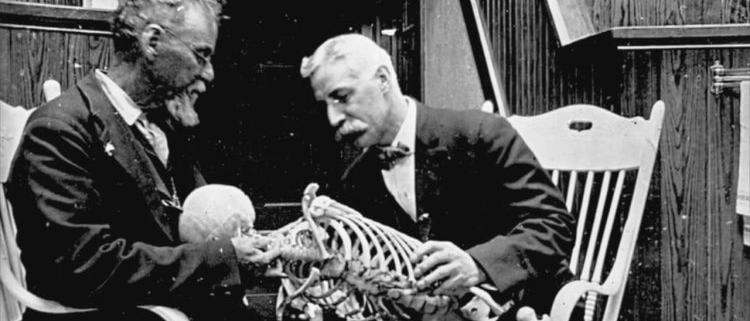
Osteopathy was developed by the American surgeon Andrew Taylor Still, who lived in the mid-19th century and founded the first osteopathic school in Kirksville, Missouri in 1892.
Although the word osteopathy comes from the Greek ‘osteon – bone’ and ‘pathos – suffering / disease’, its meaning is much broader than simply ‘suffering of the bones’.
The osteopath uses manual contact to carry out osteopathic diagnosis and treatment. They take into account the structural and functional integrity of the body, which tends to heal itself.
To allow the body to heal itself, osteopaths, using various manual techniques, improve fisiological and structural functions, thus restoring balance to the system.
According to osteopathy, the body is a dynamic functional unit, where several systems interact with each other, and their homeostasis leads to a person’s well-being.
This is why osteopaths are considered ‘holistic’, given their great ability to perceive and identify the various systems that make up the body/mind and, thanks to their treatment, restore balance between them.
The manipulative techniques used in Osteopathy vary precisely because there are several systems to work on, so the osteopath after his osteopathic diagnosis can work by choosing between several types of manual treatment depending on the system to be re-balanced.
WHAT DOES AN OSTEOPATH TREAT?
Osteopathy is a system of assessment, treatment and prevention of a wide variety of body problems.
Osteopaths are commonly known for treating lower back pain, whiplash, postural problems including changes in pregnancy, headaches or overload due to a working position or an injury.
Osteopaths can also help people with digestive, circulatory or nervous problems, insomnia problems and much more.
The osteopathic patient ranges from the newborn to the elderly and includes all people who have pain, including pregnant women, children and athletes.
- Headaches
- Sciatica
- Cervicalgia
- Lower back pain
- Gonalgia (knee pain) and injuries
- Disc problems
- Vertigo and ear infections
- Osteoarthritis – knees, hips, shoulders and spine – helps improve movement
- Hip pain
- TMJ (temporomandibular joint) dysfunctions
- Sports injuries
- Shoulder pain, subluxation, rotator cuff problems, impigment
- Scoliosis
- Plantar fasciitis, pain in the ankles, feet.
- Post-surgical situations
- Postural pain
- Reflux
- Constipation
- Postpartum problems in mothers and newborns
- Assessment and treatment of newborns for colitis, torticollis, plagiocephaly, flat head (Non-pathological)
TECHNIQUES USED
The osteopath, based on the assessment he has made, can decide which types of technique are most suitable for the patient. The choice of technique varies according to the problem, the pain the patient is experiencing at the time, and the approach the operator wishes to use at the time.
These are criteria that osteopaths choose personally, and it is not certain that all osteopaths use the same techniques or the same approach for the treatment of low back pain, as it varies precisely according to the patient’s problem and the osteopath’s choice of technique or not.
In osteopathy there are types of techniques, which are divided into:
– musculoskeletal
– myofascial
– visceral
– cranial sacral
Musculoskeletal techniques
Osteopathic musculoskeletal techniques have therapeutic efficacy for many ailments; the most common are back or neck pain, but in general any joint, muscular or skeletal pain can be relieved.
The aim is to restore the patient’s normal range of movement in the body segments that have lost it; musculoskeletal techniques therefore aim to restore the correct mobility of the bone, muscle and joint structure after changes in the mobility and function of the structures themselves.
Osteopaths often collaborate with other health professionals, such as physiotherapists, physiatrists or orthopaedic surgeons.
Musculoskeletal techniques restore mobility and bring joints back into the correct position according to their respective axes of movement, allowing joint mobility to recover.
The osteopath tends to intervene with rapid and very precise movements at the exact point where the area to be treated is located; precisely this speed and precision of manipulation allows mobility to be restored in more or less short times.
A frequently used technique is thrust, which involves the use of high-speed forces and reduced amplitude to quickly restore the mobility of the bone and joint structure, resulting in the release of tension and pain.
Other structural techniques move the joints more gently, manipulate, stretch and press the muscles to relax and rebalance.
Myofascial techniques
Osteopathic myofascial techniques are whole-body release and massage techniques that aim to reduce pressure on muscles and fascia.
The fascia is a connective tissue that covers the muscles of our entire body, blood vessels, bones and nerves like a net and supports the organs.
The osteopath aims to release the tensions that can affect this dense, elastic connective tissue and which can cause difficulty in movement and pain, for example in the back, head, or fibromyalgia, adhesions from scars and much more.
Accidents, repetitive stress, sports trauma, scars and incorrect postures are frequent causes of a lot of fascial tension, which find valuable help in Osteopathy.
The osteopath examines the posture and through palpation identifies the areas characterised by stiffness, both on the surface and deeper down.
Many fascial techniques involve gentle manipulations that release tension and relax, soften and stretch the fascia and muscles.
Visceral Techniques
There is a close relationship between the viscera and the musculoskeletal structure, in other words, between function and structure: a malfunction of the structure, and in particular the spine, affects the viscera and vice versa.
The French osteopath J.P. Barral had already demonstrated the effects of visceral manipulation on the rest of our body, especially the lumbar and sacral tracts.
Restrictions at the visceral level are therefore reflected in posture: if an organ can no longer move in a normal way, it creates tensions that are gradually reflected in the structure, leading to rigidity, the impossibility of maintaining an upright position and making certain movements.
Tension in a certain part of the body causes the person to bend, as if to wrap around it, towards that part.
The osteopath observes the posture, asks questions related to lifestyle and general medical history and then identifies the most tense areas of the patient’s body through palpation.
Depending on the disorder, delicate manipulation may be necessary or more painful if the area of restriction is very stressed.
The osteopath’s aim is not to force the body into an ideal posture, which is impossible for the patient, but to help it restore the best possible visceral mobility within its limitations.
Dysfunction and incorrect posture are contained and, consequently, the pain and stress to which the body is subjected are reduced.
Visceral osteopathic techniques
Cranial Sacral Technique
The cranial sacral osteopathic technique is based on the knowledge of the existence of the primary respiratory mechanism and cranial mobility discovered at the time by W. Sutherland.
These techniques act on the movements affecting the bones of the skull and sacrum, as well as on the fluid surrounding the central nervous system, with the aim of restoring balance to the cranial and sacral functions.
The osteopath, through cranial sacral treatment, releases the spontaneous and involuntary mobility of the bones, which from the skull spreads throughout the body through the membranes in which the cerebrospinal fluid circulates with a very slight movement.
The mobility that the osteopath ensures also allows the skull to adapt to the involuntary movement of the brain.
Far from being invasive, cranial manipulation is able to relieve the physical tension and stress that can obstruct or interrupt cranial movement and, consequently, the regular functioning of our body.
Ultimately, the entire vitality of our organism benefits from it. Cranial osteopathy can cure or relieve various types of disorders, such as dysmenorrhoea, digestive difficulties, sleep disorders, depression, headaches, neck and back pain, motor problems, nervous or relationship problems, malocclusions and much more.
Cranio-sacral techniques can be included in the treatment of biodynamic osteopathy
In any case, these are problems that are not strictly related to the skull. What’s more, because it’s a delicate technique, it’s suitable for all ages, from babies to the elderly and pregnant women.
REGULATION OF OSTEOPATHY IN PORTUGAL
On 15 July 2003, the Portuguese Parliament approved Law no. 45/2003 – ‘Law on the Framework of Non-Conventional Therapies’ (TNC), which includes Osteopathy, through Parliament resolution no. 64/2003. On 2 September 2013, with Law no. 71/2013, Osteopathy was regulated like other NCTs. This was followed by the publication of various ordinances: – Ordinance no. 181/2014 of 12 September, which ‘regulates access to the professional card for therapists who, on the date of entry into force of the aforementioned law, are practising in one of the areas of TNC’; – Ordinance no. 182/2014 of 12 September, which regulates access to the professional card for therapists who, on the date of entry into force of the aforementioned law, are practising in one of the areas of TNC’. Ordinance no. 182/2014 of 12 September, which defines that ‘the legal regime to which the opening, modification and operation of private health service units are subject shall apply, with the necessary adaptations, to the places where TNC is provided’; – Ordinance no. 182-A/2014 of 12 September, which ‘provides that a fee to be set by ordinance shall be payable for the issue of the professional card…’ – Ordinance no. 200/2014 of 3 October, which ‘obliges TNC professionals to have civil liability insurance within the scope of their professional activity, which must comply with the minimum conditions listed here…’ – Ordinance no. 207-B/2014 of 8 October, which ‘aims to establish the characterisation and functional content of the osteopathic profession’; – Ordinance no. 172-E/2015 of 5 June, which ‘regulates the general requirements that must be met by the cycle of studies leading to a degree in Osteopathy’; – Law no. 1/2017 of 16 January, which establishes the value added tax (VAT) exemption regime applicable to TNC activities; – Law no. 109/2019, which modifies the system for awarding professional certificates 2013, with the second amendment of Law no. 71/2013 of 2 September. Law no. 109/2019 modifying the 2013 system for awarding professional licences, with the second amendment to Law no. 71/2013 of 2 September, with the regulatory process having been immediately restarted, with the award of the respective licences.
Ultimos Artigos
 Baby colic: Symptoms and Osteopathy in LisbonFebruary 11, 2026 - 10:18
 Pregnancy pain: the benefits of osteopathyFebruary 3, 2026 - 17:06
 Tongue position: how it affects the bodyDecember 30, 2025 - 12:22
 Hip pain: Causes, Symptoms and RemediesMarch 5, 2025 - 09:54
 Baby Flat Head Treatment Lisbon – Osteopath Sebastian GuzzettiJanuary 1, 2025 - 13:36